Something shifted quietly in how development teams work over the last year.
AI coding assistants - Claude Desktop, Cursor, Windsurf — stopped being "helpers that suggest code" and became the primary interface through which developers get things done. You describe what you need. The agent acts.
The natural next question: what can the agent actually do?
That's where the Model Context Protocol comes in.
MCP in Plain English
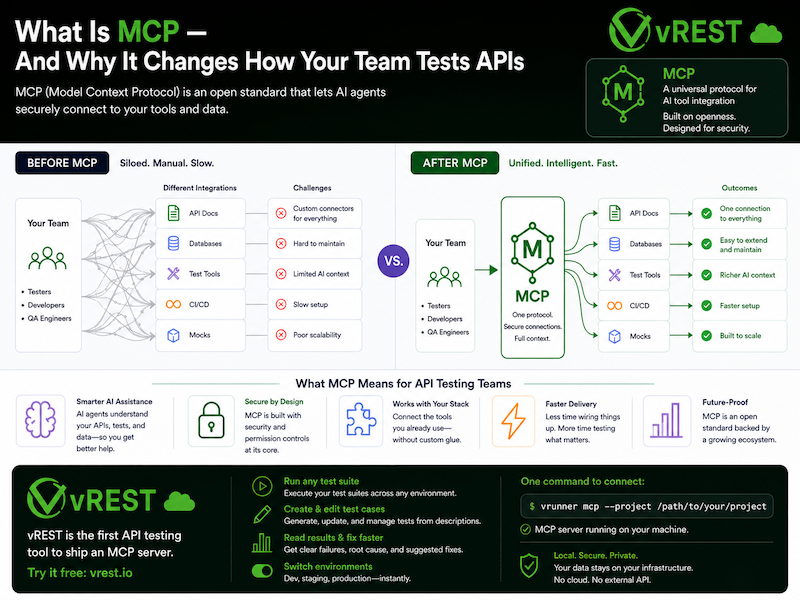
The Model Context Protocol (MCP) is an open standard from Anthropic that gives AI agents a standardised way to connect to external tools. Before MCP, every AI-to-tool integration was custom-built and fragile. MCP standardises it — build a server once, and any compatible AI host can use it.
Think of it like USB-C for AI tools. One standard port. Every tool that ships an MCP server becomes accessible to every AI agent that speaks the protocol.
Claude Desktop, Cursor, Windsurf — they all speak MCP.
What This Has to Do with API Testing
Here's the part that matters for QA teams.
Until now, API testing sat outside the AI workflow. Your AI assistant could help you write a test, but running the suite, reading failures, updating assertions - that still meant switching to a separate tool.
With an MCP server, that changes. An AI agent can now directly operate your API testing tool. Not help you use it - actually use it. Trigger a test suite, read the results, interpret a failure, create a new test case - all from a natural language prompt, inside the same conversation where you're already working.
vREST Is the First API Testing Tool to Ship an MCP Server
In v3.6.0, vREST shipped a local MCP server via vrest-ng-cli.
One command:
vrunner mcp --project /path/to/your/project
Your AI agent can now:
- Run any test suite in your project
- Create and edit test cases from a description
- Read results and surface exactly which assertions failed
- Switch between environments (
dev, staging, production )
All from a prompt. No tab-switching. No copy-pasting results.
A Quick Example
With the MCP server connected to Claude Desktop, a session looks like this:
You: Run the checkout API suite against staging. Tell me what broke.
Claude: Done. 11 passed, 1 failed —
TC-089, expected a 200 but got
404 on /orders/confirm.
Looks like the endpoint path changed.
Want me to update the test case?
That's it. No opening vREST. No reading through a log. The agent runs, reads, and proposes a fix — in the same flow.
Why Local Matters
The vREST MCP server runs on your machine. Not in the cloud. Not via an external API.
That means your API credentials and test data stay within your infrastructure. APIs on your intranet or behind a firewall are fully accessible. No tunnel, no proxy, no security exceptions needed.
For teams in healthcare, fintech, or any regulated environment - this isn't a nice-to-have. It's the only architecture that works.
This Is Early Days - Which Is the Point
MCP is still early. Search volume for "mcp api testing" is low today. But it's growing fast, and the teams who build MCP into their workflow now will have a head start that's hard to close later.
No other API testing tool has shipped an MCP server yet. vREST is first.
We'd like to know what you build with it.